The Math NYC Families Already Know: Renting Is No Longer the "Safe" Choice
By Teresa of Making Westchester Home
If you're a family renting a two- or three-bedroom apartment in New York City right now, you already feel it in your bank account before you feel it anywhere else. A new StreetEasy analysis of U.S. Census Bureau data confirms what so many of our clients tell us at the kitchen table: renting a home big enough for a family in NYC has become one of the most expensive ways to live in the region — and owning a freestanding single-family home in a Westchester commuter town is often the more affordable path, not the more ambitious one.
Here's what the numbers actually say, and what they mean if you're weighing a move up the Hudson line.
The rent burden isn't new — it's just gotten sharper
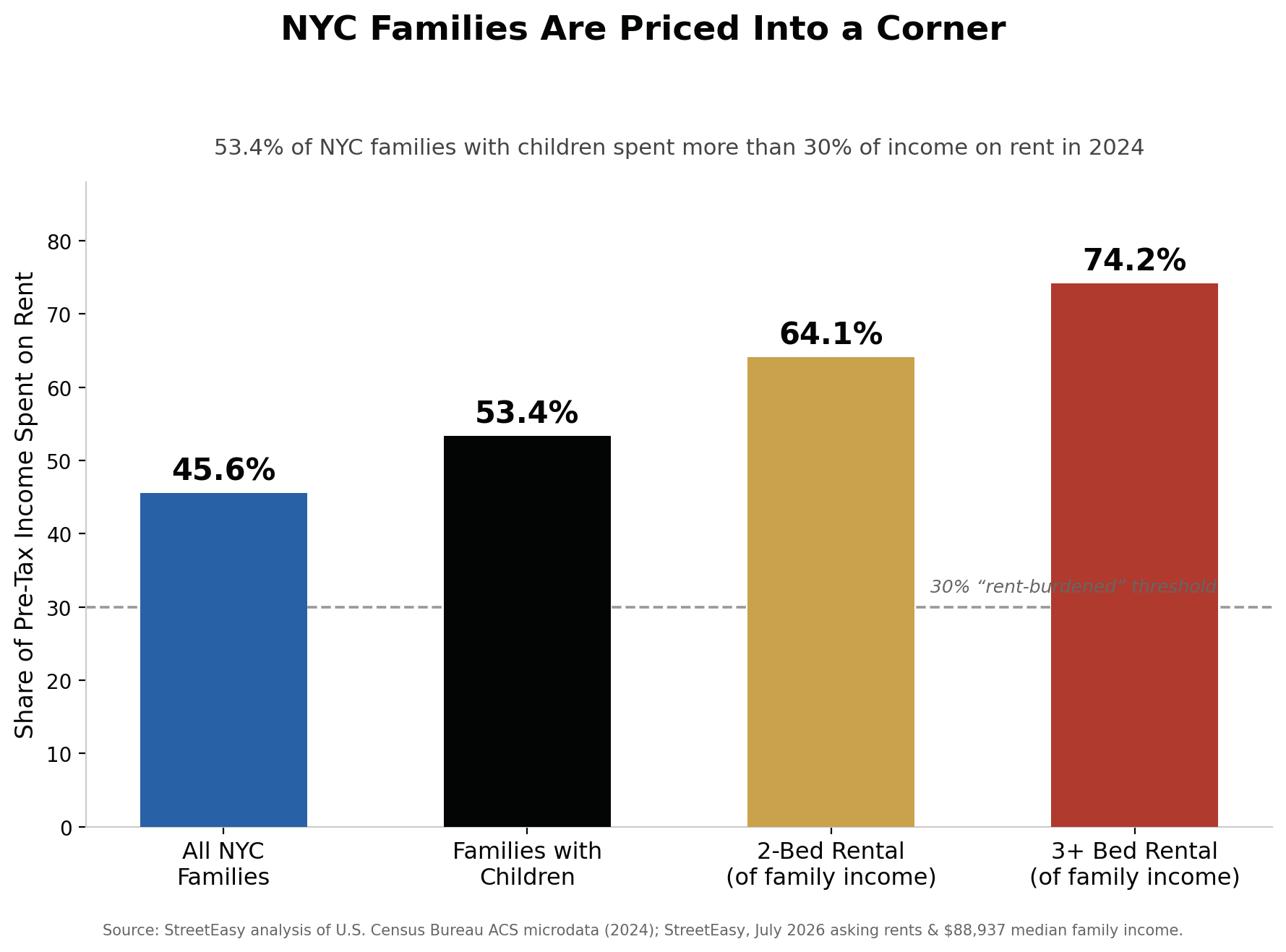
According to StreetEasy's analysis of American Community Survey microdata, 53.4% of NYC families with children under 18 spent more than 30% of their income on rent in 2024 — the widely used threshold that defines "rent-burdened." That's not a pandemic-era spike; families with kids have carried an outsized rent burden for well over a decade, peaking at 60.5% in 2014 before easing slightly and then climbing back up as post-pandemic rents took off.
By comparison, 45.6% of all NYC families — not just those with children — crossed that same 30% threshold in 2024. Raising a family in this city costs more, proportionally, than most other kinds of households face.
Family-size apartments are scarce, and it shows in the price
Part of the squeeze is simple supply and demand. StreetEasy found that citywide inventory of rentals with three or more bedrooms fell 19.8% year-over-year as of July 2026, down to just 3,299 units across the entire five boroughs. Two-bedroom inventory held roughly flat at 7,748 units. Together, apartments with two or more bedrooms made up only 43.3% of NYC's rental listings that month — down from 49.6% before the pandemic in 2019.
Scarcity plus demand pushed pricing to levels that would have seemed extreme a decade ago:
Citywide median asking rent for a two-bedroom: $4,750/month (up 5.6% year-over-year)
Citywide median asking rent for a three-or-more-bedroom: $5,500/month (up 3.9% year-over-year)
Manhattan median asking rent for a three-or-more-bedroom: $8,000/month (up 3.2% year-over-year)
Run those numbers against the $88,937 median annual income for an NYC family with children, and a two-bedroom rental alone consumes 64.1% of that income. A three-or-more-bedroom rental consumes 74.2% — nearly three-quarters of a family's pre-tax earnings, on rent alone.
So what does the alternative actually cost?
This is the question we hear most from NYC families who've started looking north: "Wouldn't owning a house cost even more?"
We ran the numbers on a real, representative example: a single-family home in Dobbs Ferry, a Metro-North commuter village on the Hudson Line roughly 25 miles — about a 40-minute express ride — from Grand Central. Recent single-family sales activity there has clustered around a $995,000 median sale price, per William Pitt Sotheby's local market data.
Here's what carrying that home actually looks like each month, assuming a 20% down payment and today's borrowing costs:
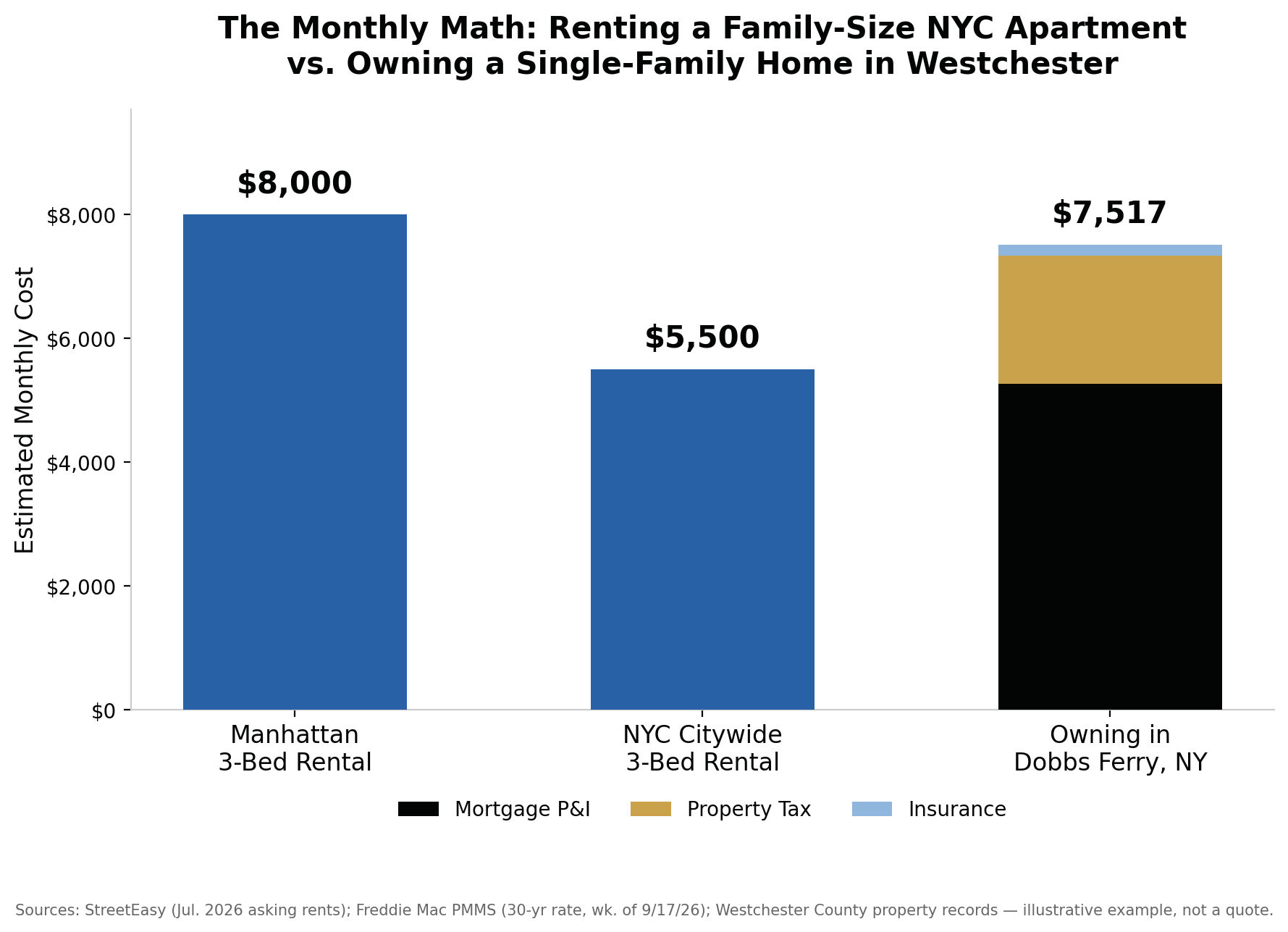
Monthly Cost Component Estimated Amount Mortgage principal & interest (30-yr fixed, 6.95%*) $5,269 Property tax (Westchester effective rate, ~2.5%) $2,073 Homeowner's insurance (est.) $175 Total estimated monthly carrying cost $7,517
Based on Freddie Mac's Primary Mortgage Market Survey for the week of September 17, 2026.
Now put that side-by-side with what a family is already paying to rent comparable space in the city:
Housing Option Monthly Cost Manhattan, 3-bedroom rental (median asking rent) $8,000 NYC citywide, 3-bedroom rental (median asking rent) $5,500 Owning a single-family home in Dobbs Ferry, NY $7,517
A family renting a three-bedroom in Manhattan today is paying $483 more per month than the estimated cost of owning a freestanding house in Dobbs Ferry — with a yard, a driveway, and no shared walls. Even against the citywide three-bedroom median, the gap narrows to roughly $2,000 a month — but only one of those two monthly payments is building equity.
Why this matters beyond the spreadsheet
A rent check and a mortgage payment aren't actually the same kind of expense, even when the dollar figures land close together:
One builds equity. One doesn't. Of that $7,517 monthly estimate, roughly $2,650 in the first year goes toward paying down principal — money that comes back to the family at resale. None of an $8,000 rent check does.
One is locked. One isn't. A 30-year fixed mortgage payment doesn't rise 5-6% a year the way NYC asking rents have. Property taxes move, but not with the volatility StreetEasy's data shows in the rental market.
Space stretches further. A single-family home in a commuter town typically means more bedrooms, a basement, outdoor space, and often better public schools — the very things families are straining to squeeze into with 43.3% of NYC's rental inventory offering two-plus bedrooms in the first place.
The commute math holds up too
Dobbs Ferry sits on the Hudson Line with express service into Grand Central in around 40 minutes — well within range for a daily commuter, and closer than plenty of outer-borough addresses that don't come with a yard.
The bottom line
StreetEasy's data confirms something we see constantly in our work with NYC families: renting isn't the "cautious" option anymore, and buying in Westchester isn't the "expensive leap." For a growing number of families, the math has quietly flipped. If you're spending 65-75% of your income to rent a home barely big enough for your family, it may be time to run your own numbers.
Curious what your specific numbers would look like? Making Westchester Home helps NYC families translate their current rent into real buying power across Westchester's commuter towns. Reach out and we'll build you a personalized comparison — just like this one — for the towns and train lines that fit your life.
Sources: StreetEasy, "More than half of families with children in NYC are rent-burdened" (Aug. 13, 2026), based on StreetEasy analysis of U.S. Census Bureau American Community Survey microdata and July 2026 StreetEasy market data. Westchester home price and tax figures from William Pitt Sotheby's International Realty market data and Westchester County property tax records. Mortgage rate from Freddie Mac's Primary Mortgage Market Survey, week of September 17, 2026. Figures are illustrative estimates for a representative property and do not constitute a loan quote, tax bill, or guarantee of savings; consult a lender and tax professional for figures specific to your situation.